The evil eye — nazar in Hindi, mati in Greek, ayin hara in Hebrew — is among the oldest, most widespread human beliefs. Across millennia and cultures, different words reflect the same instinct: a glance carrying envy or ill will can bring harm, but the right symbol, worn close, can repel it.
Today, the evil eye ring sits at the crossroads of ancient belief and style. People wear it for protection, aesthetics, or both. This guide explains its meaning, origins, evil eye ring designs, and how to choose one that suits you.
Evil Eye Ring Meaning in Short
- An evil eye ring is believed to protect the wearer from negative energy, jealousy, and ill intent. It offers peace of mind and a sense of security.
- This protection deflects harmful energy from the wearer, helping maintain positivity and emotional well-being.
- Wearing the symbol daily serves as a constant reminder of protection and helps reinforce a mindset of awareness and intention.
- Available in gold, diamond, and rose gold finishes, with the blue evil eye ring being the most widely recognised version
- Suitable for both everyday wear and gifting
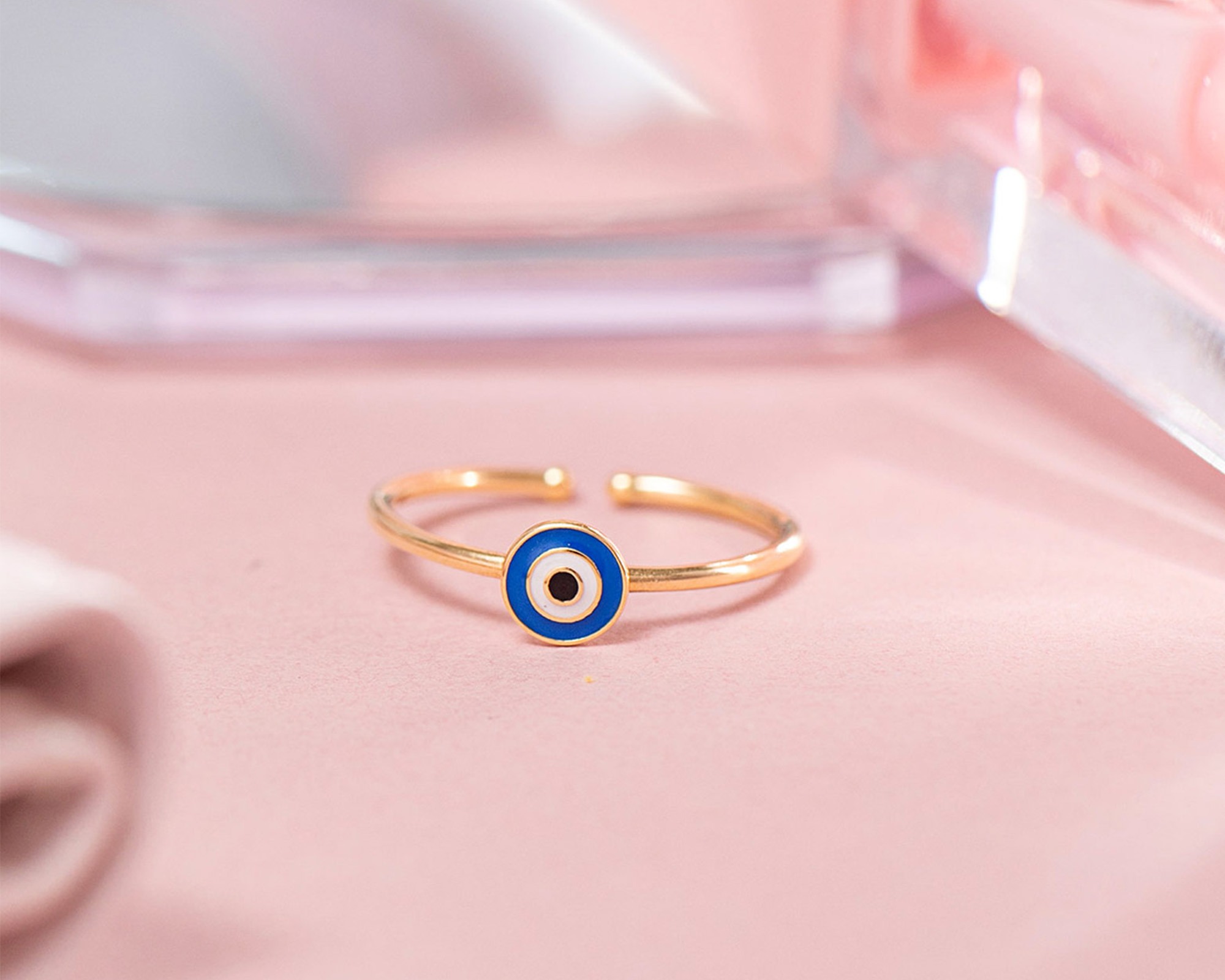
What is the Meaning of an Evil Eye Ring?
Evil eye (nazar) is rooted in the belief that a look of envy, even an unconscious one, carries real energy. This energy can cause misfortune, illness, or bad luck for the person it lands on. The evil eye protection ring works as a counter: wearing the symbol creates a deflecting force. This force redirects negative energy before it can take hold.
A ring of the evil eye takes this one step further by placing the symbol on the hand, one of the most visible and active parts of the body, constantly in contact with the world. There is something fitting about that placement: the hand that reaches out, works, and connects with others also carries the symbol of protection.
For many people today, the meaning operates on two levels simultaneously. There is the spiritual or cultural dimension — the genuine belief in nazar and its effects — and there is the more personal dimension: wearing something that reminds you to stay grounded, protected, and aware of your own energy. Both are entirely valid reasons to wear one.
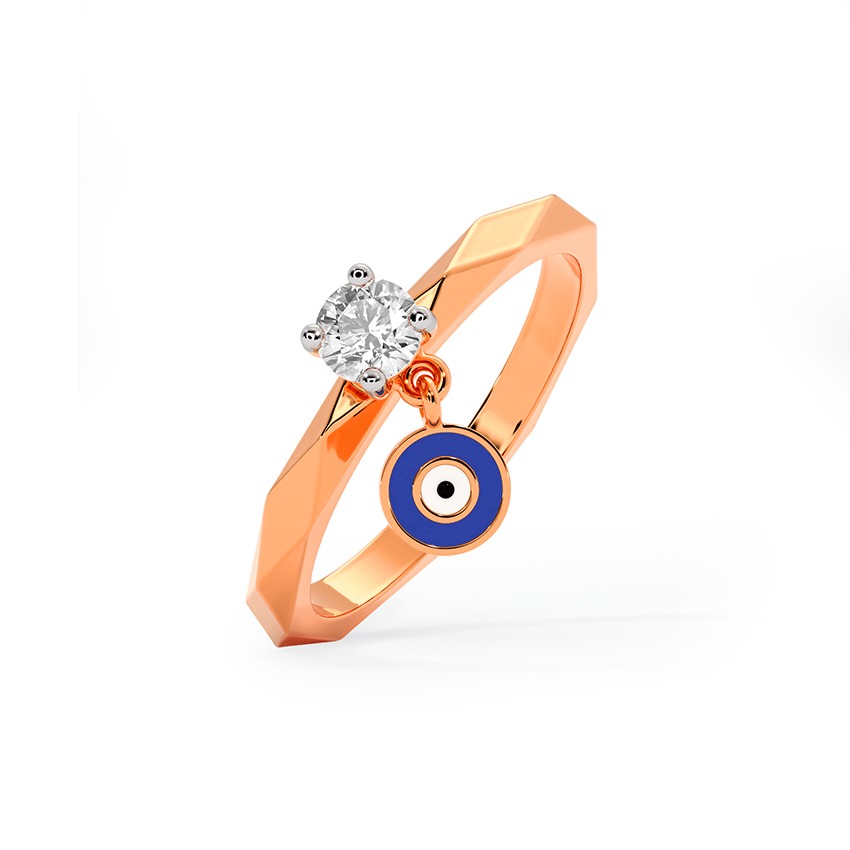
The Symbolism of Colours in Evil Eye Jewellery
Colour is not incidental in evil eye symbolism — different shades carry distinct meanings that have been consistent across cultures for centuries.
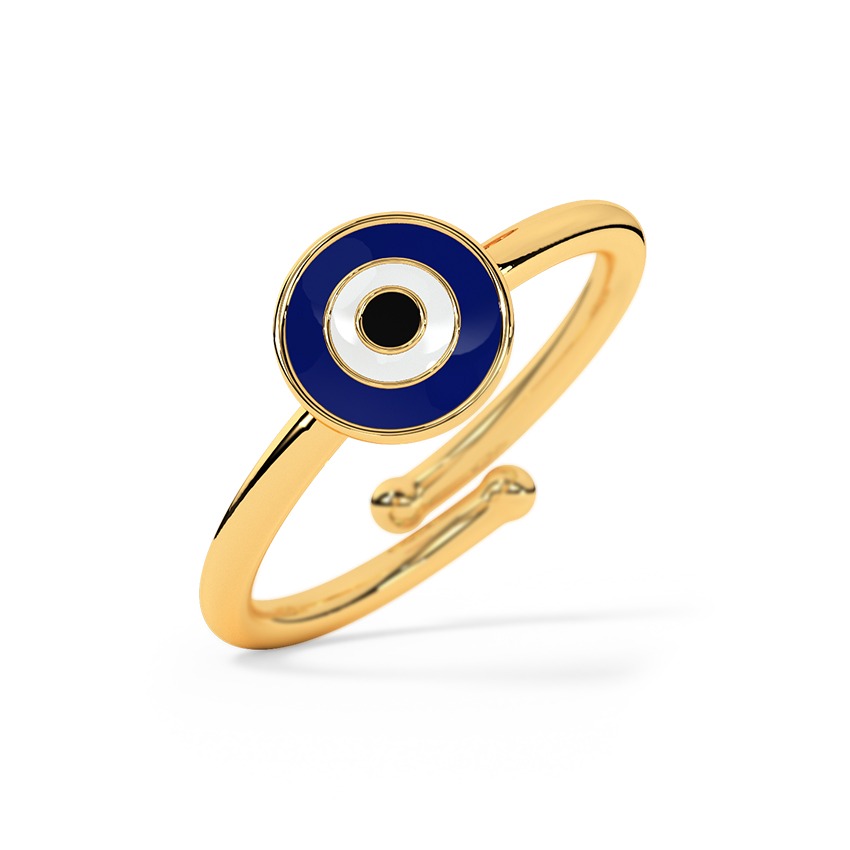
The blue evil eye ring is the most recognisable and most widely worn. Blue — particularly deep cobalt or turquoise — is associated with protection, calm, and the deflection of negative energy. It is the colour of the sky and water, elements that many traditions associate with clarity and spiritual cleansing.
A gold evil eye ring brings its own meaning: strength, vitality, and prosperity. Gold adds to the protective quality of the symbol and holds material significance in almost every culture. White evil-eye stones or settings symbolise clarity, focus, and pure intention.

Origin of the Evil Eye Belief Across Cultures
Few beliefs have travelled as far or persisted as long as the evil eye. Understanding its origins gives the symbol depth, making it feel more considered than merely fashionable.
In Greek tradition, the evil eye — mati — has been a central part of folk belief for over three thousand years. The classic blue-and-white eye amulet originated here, and Greek evil eye rings and jewellery remain among the most recognised forms of the symbol worldwide. The Greeks believed that excessive praise or admiration could inadvertently transmit the evil eye, making protection necessary even in positive social interactions.
The Turkish nazar boncuğu — the blue glass eye bead — is perhaps the best-known evil eye symbol today. In Turkey, people hang these beads in homes, give them to newborns, and wear them as jewellery. The tradition of wearing a Turkish evil eye ring is part of daily life. Here, the nazar is a practical necessity, not just a superstition.
Across the Middle East, South Asia, and the Mediterranean, variations of the same belief appear under different names but with consistent logic: envy is a form of energy that can cause harm, and a symbolic eye worn on the body acts as both a warning and a shield.
In India, nazar is a familiar concept across communities and generations. Black kohl marks on children’s faces, dark threads tied on wrists, and amulets worn close to the body are all expressions of the same protective impulse as the evil eye ring.
Why People Wear an Evil Eye Ring Today
The evil eye’s journey from ancient amulet to contemporary fine jewellery is genuinely interesting. What was once a protective charm made from glass or clay now appears in 18KT gold with diamond settings — and the shift says something meaningful about how belief and aesthetics have converged.
Part of what has driven this is a broader cultural comfort with jewellery that carries intention. People increasingly want the things they wear to mean something — and the evil eye, with its long history and clear symbolism, offers exactly that. It is not a vague “positive energy” symbol; it has a specific story, a specific function, and a visual identity that is immediately recognisable.
In India, in particular, the combination of a familiar cultural belief and genuinely beautiful fine jewellery has made evil eye rings increasingly popular as both personal purchases and gifts.
Fashion Meets Meaningful Jewellery
The evil eye translates well into jewellery design because the symbol itself is visually compelling — the concentric circles, the contrast of dark and light, the suggestion of an eye watching outward. In minimal gold settings, it reads as modern and refined. In diamond-set versions, it becomes something more substantial. It works as a small, everyday piece and as a statement ring, giving it unusual versatility across contexts and personal styles.
The Rise of the Men’s Evil Eye Ring
The symbolism of the protective evil eye is gender-neutral, and the design of men’s evil eye rings reflects this. Band-style rings with the evil eye motif integrated into the design, as well as more minimal settings where the symbol is present but not dominant, have made this a growing category for men. The same cultural resonance applies equally, and the shift toward men wearing meaningful jewellery has made the evil eye ring a natural fit.
Evil Eye Ring Styles: A Design Overview
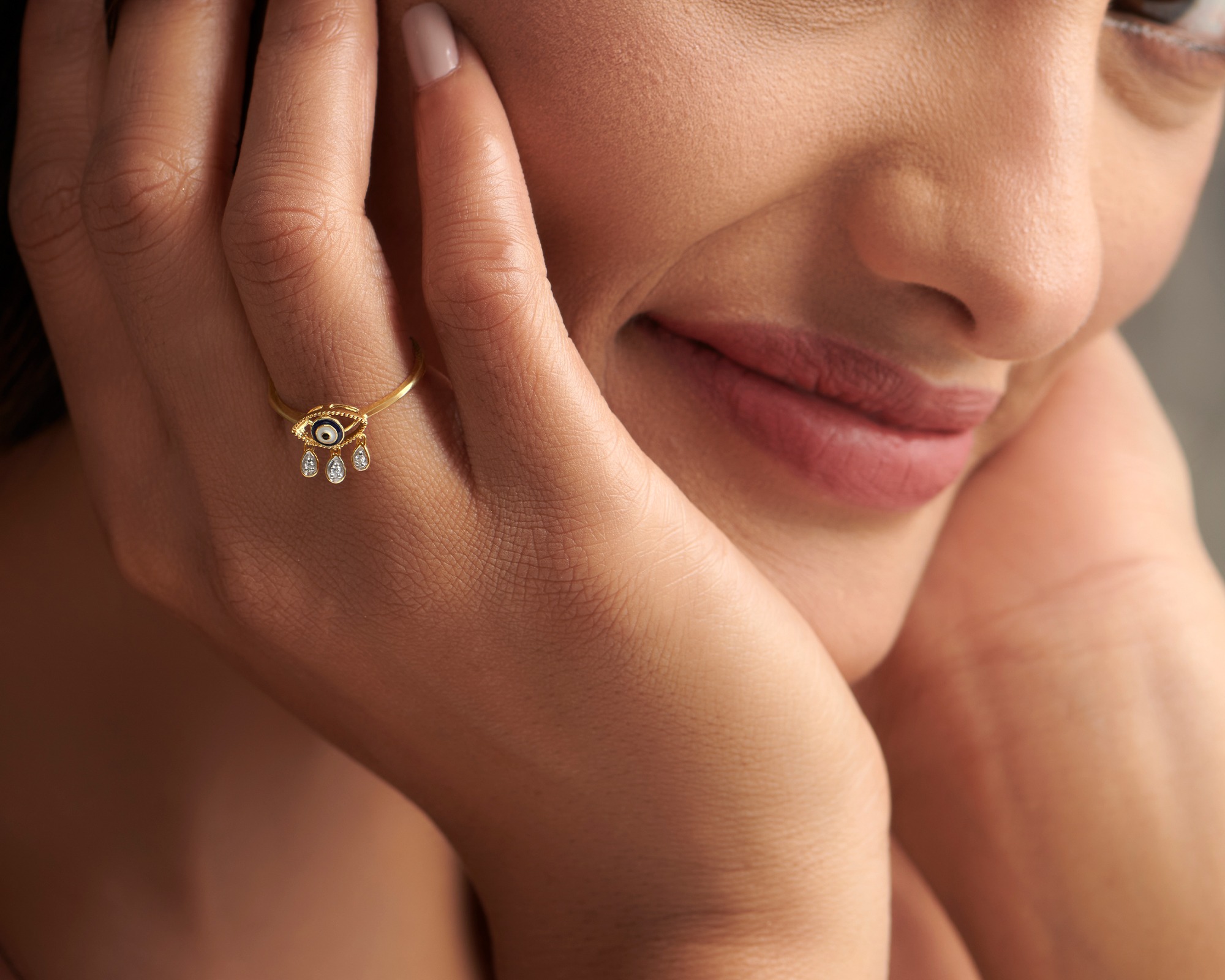
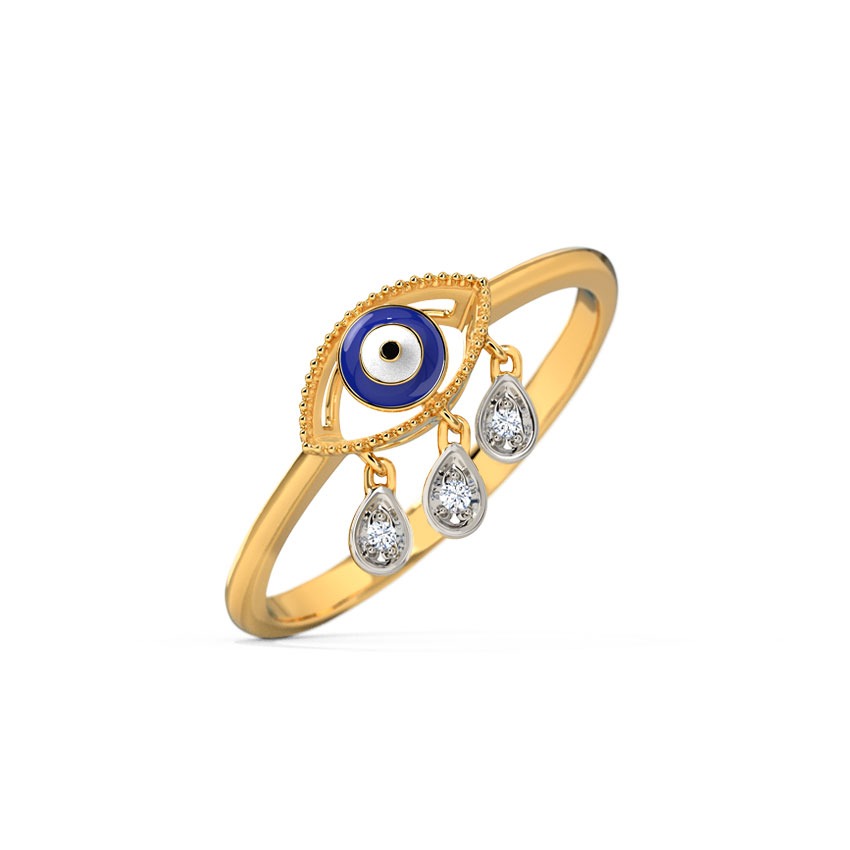
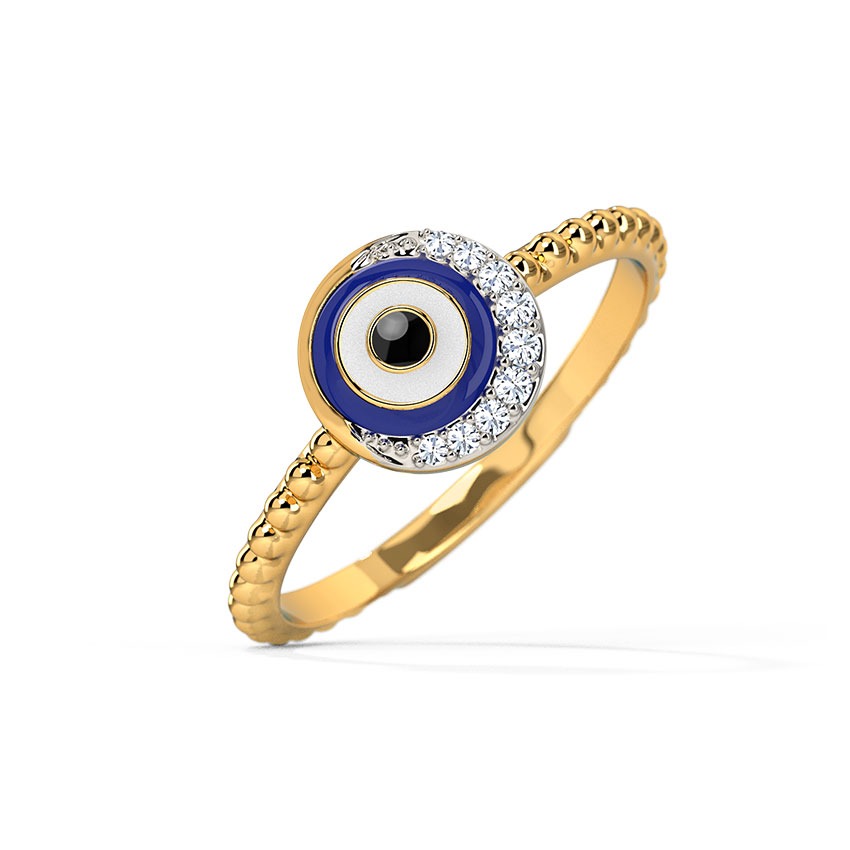
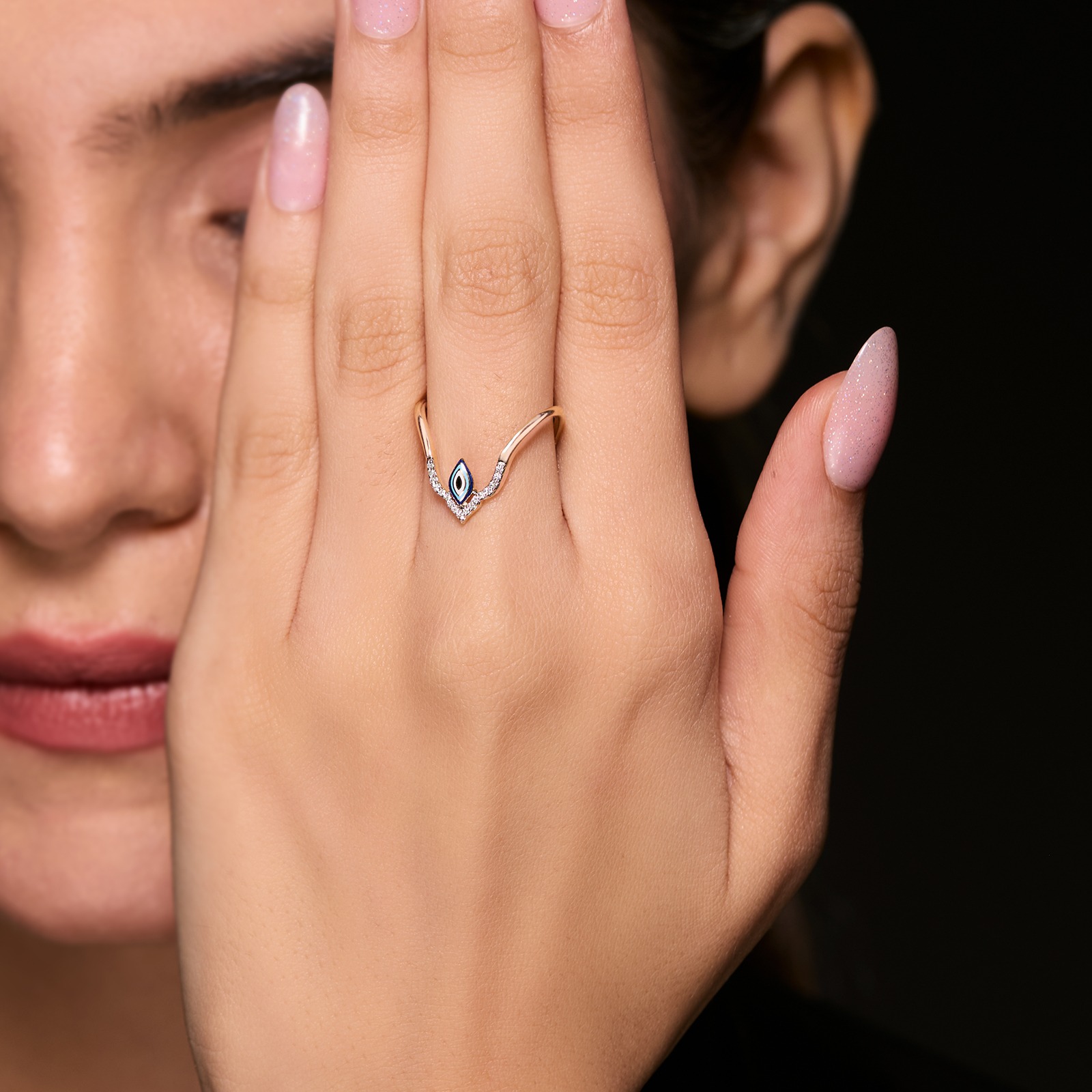
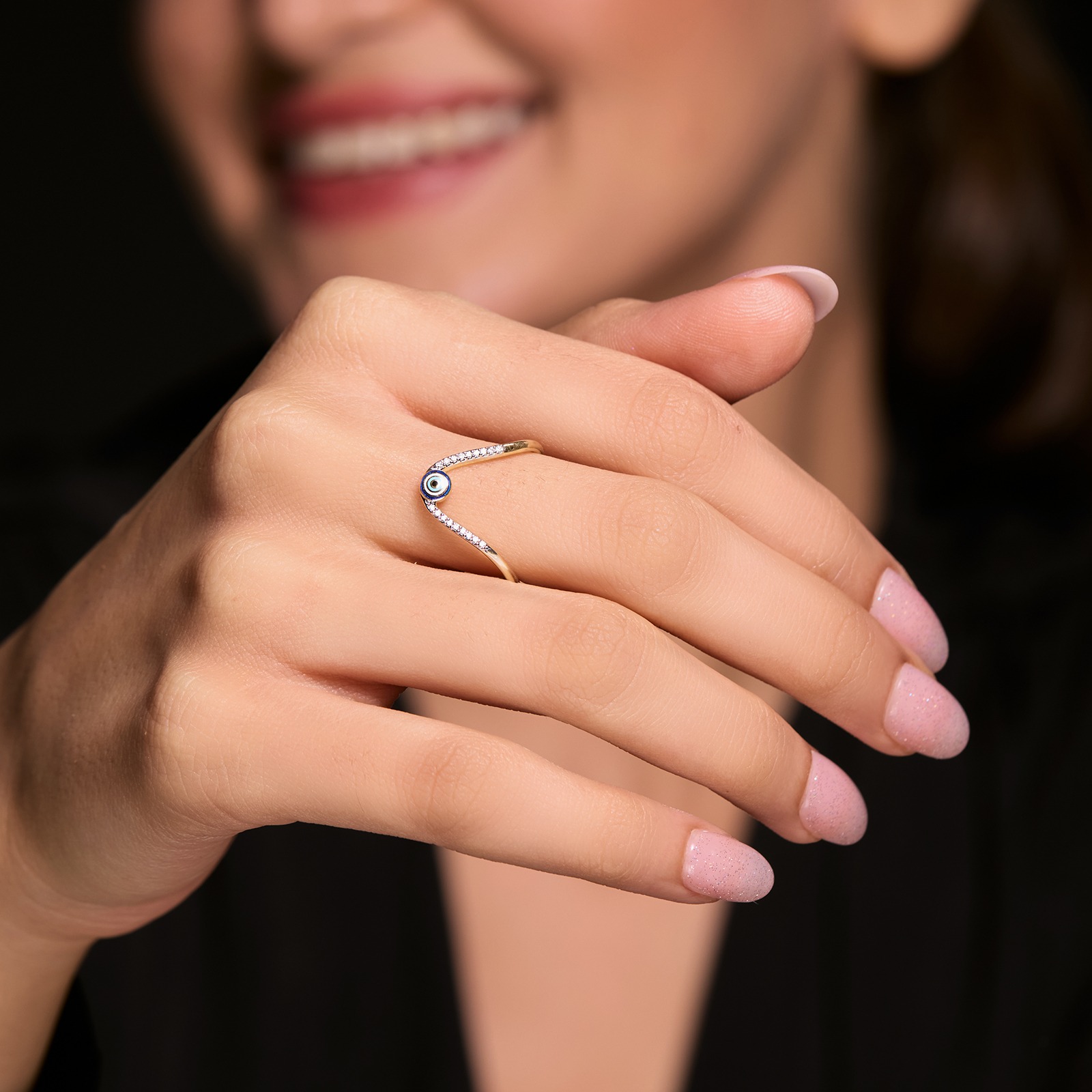
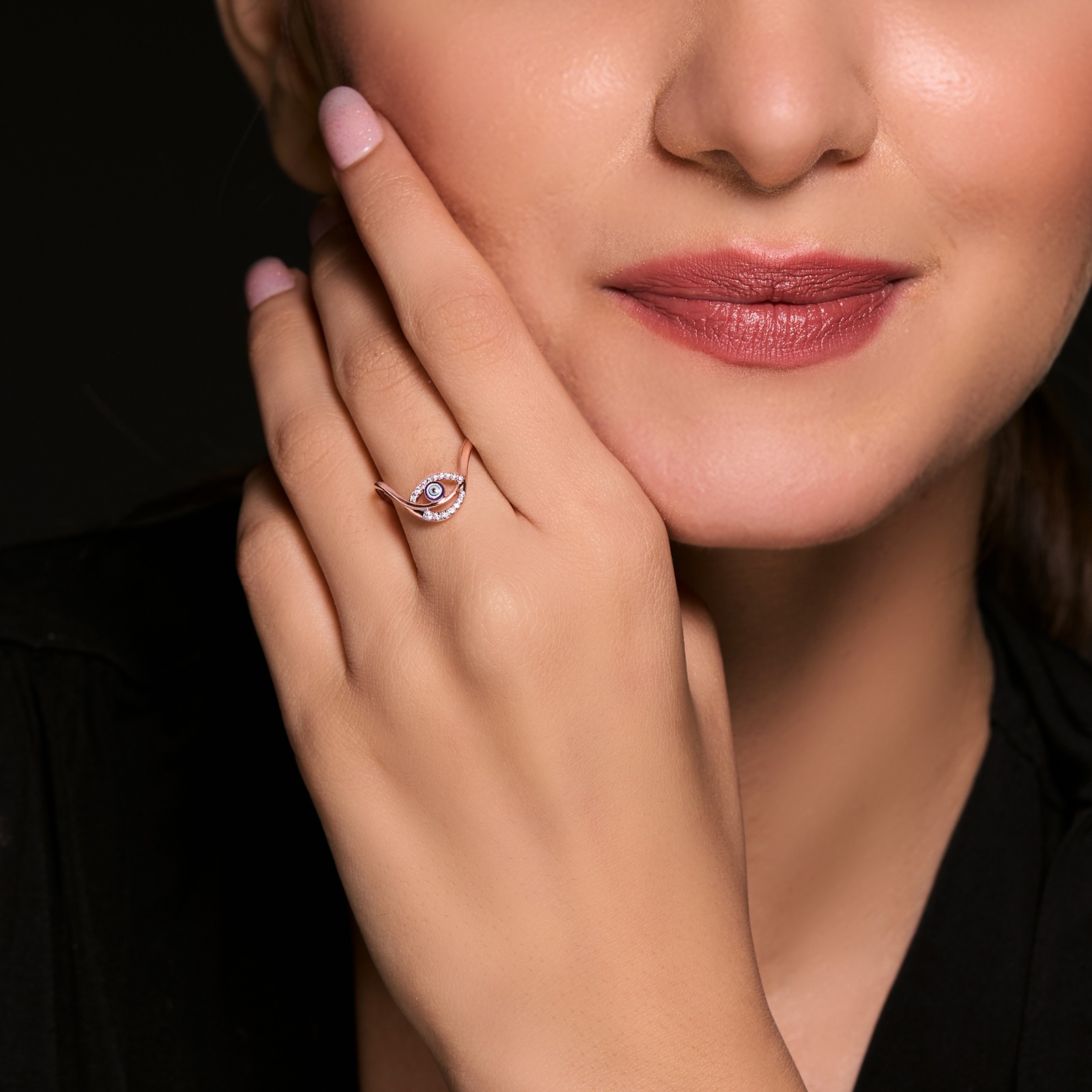
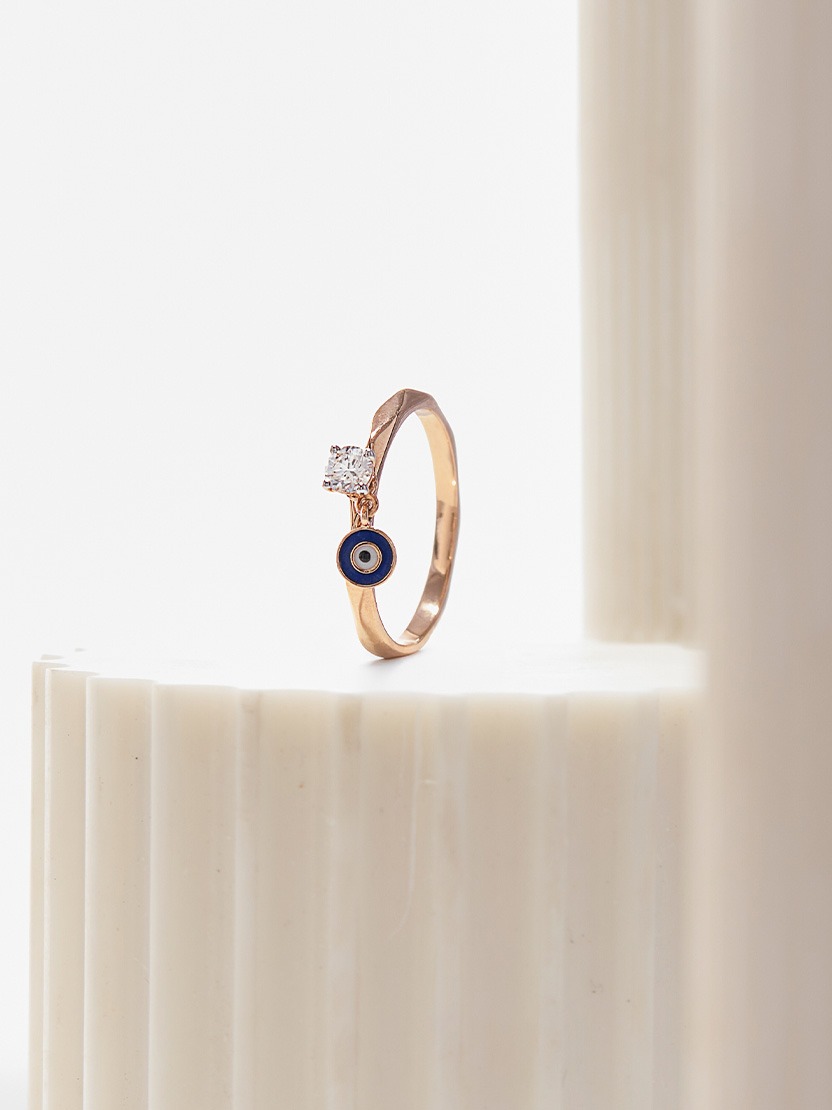
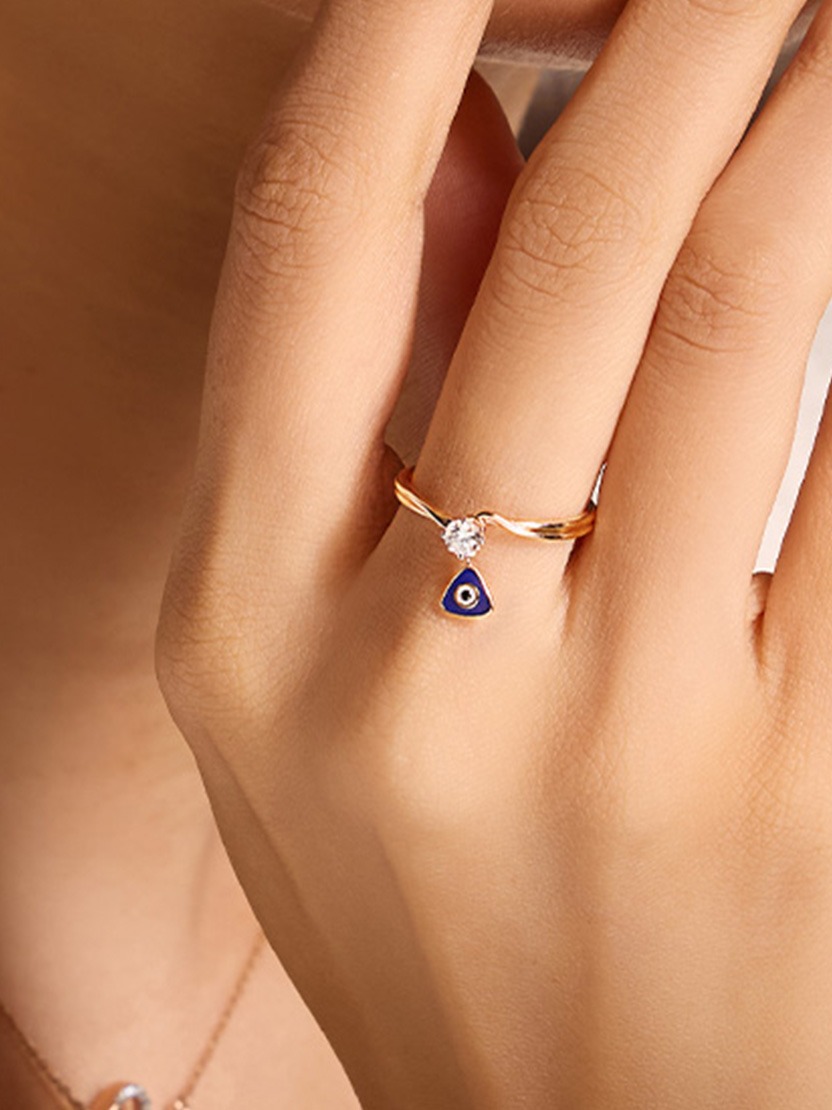
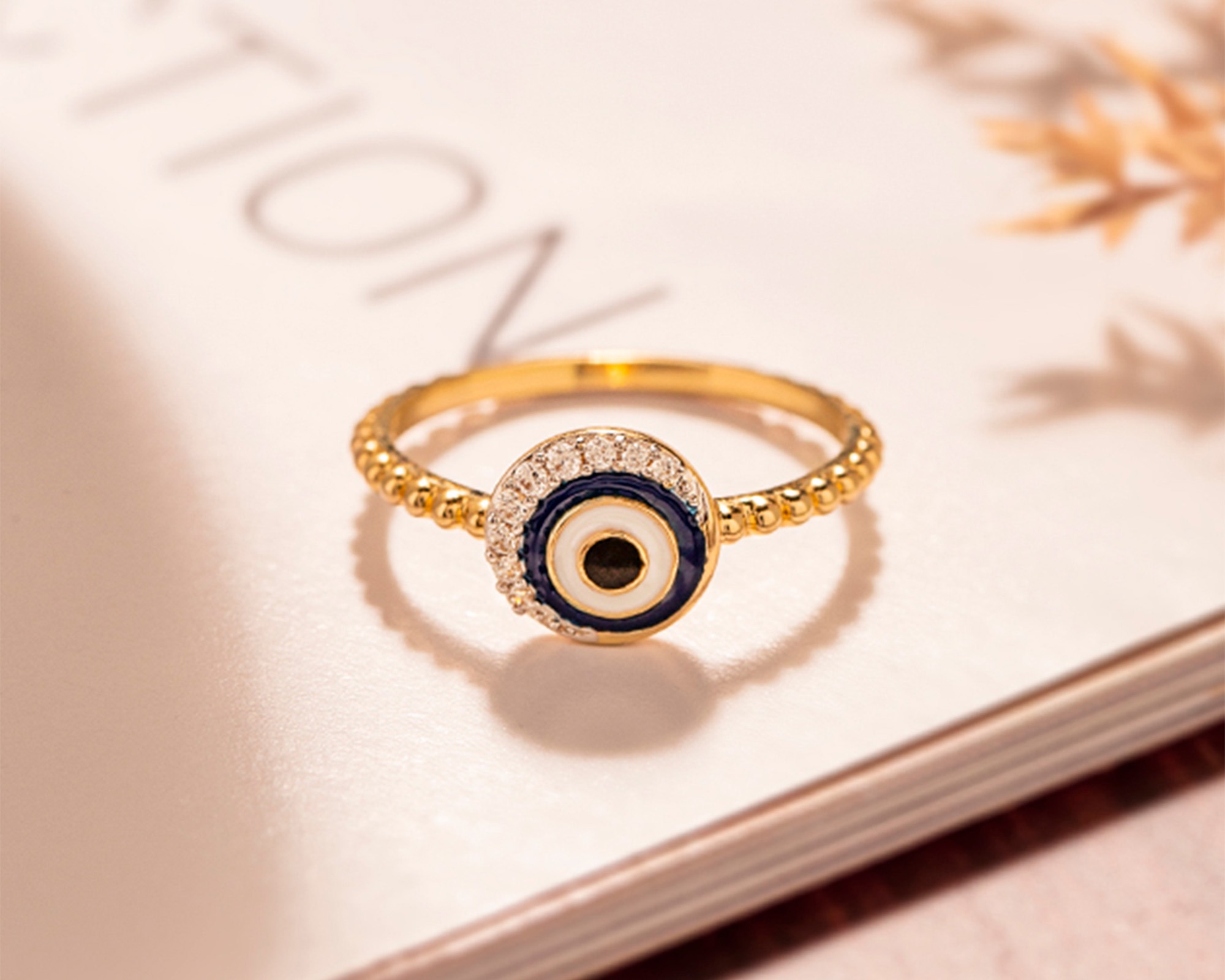
The evil eye appears in many forms in ring designs. On one end, there are evil eye charm rings. These feature the symbol as a central element on the band. They are easily recognisable and often set with stones or diamonds for depth. These motifs are the most direct and popular expressions of the evil eye.
Band-style designs take a more subtle approach. Here, the evil eye is part of the ring’s continuous form. The symbol may be repeated around the ring, as in an eternity style. Or it may appear as a single, flush element within the band. These designs feel architectural. They work especially well for stacking and everyday wear when a lower-profile ring suits the context.
Chain rings and hanging designs bring movement. The evil eye part is suspended or linked by a delicate chain, so it moves gently with the hand. Vanki-style evil-eye rings from South Indian tradition are more sculptural. They wrap the finger and suit festive or bridal looks.
Across all formats, the choice of metal shapes the piece’s character. Gold evil eye rings — especially yellow — offer warmth and cultural familiarity suited to everyday and traditional wear. Rose gold has a softer, more modern quality. Evil eye diamond rings, with stones set to define the eye, bring brilliance that makes the symbol as much fine jewellery as protection.
How to Wear Your Evil Eye Ring for Maximum Protection
Wearing an evil eye ring is as much about intention as it is about placement. That said, there are a few traditional beliefs around how and where to wear it that are worth knowing — both for those who take the symbolism seriously and for those who are simply curious.
Which Finger Should I Wear an Evil Eye Ring On?
There is no single rule on this — traditions vary, and personal preference matters as much as convention. The most commonly cited guidance draws on the distinction between the left and right hands.
The left hand is linked to intuition and receptivity. Wearing an evil eye ring on your left hand is thought to shield the emotional and inner self. The right hand is tied to action and outward energy; wearing the ring on your right hand is believed to empower your outgoing energy.
In practice, many people simply wear it on whichever finger feels comfortable and looks right to them, which is equally valid.
Pairing it with the Hamsa Symbol
The hamsa evil eye ring, or the pairing of the two symbols, is a natural combination. The hamsa — an open palm with an eye at the centre — shares the evil eye’s protective logic and appears across Middle Eastern, North African, and South Asian traditions. Wearing the two symbols together is understood as layered protection: the eye deflects negative energy, the palm of the hamsa blocks it at the threshold. As a jewellery combination, the two work visually and symbolically.
Common Myths About Evil Eye Rings
A few beliefs about evil-eye jewellery circulate widely enough to warrant direct address.
Myth: An evil eye ring only works if it is gifted to you.
Fact: This is a common belief, but not a universal one. Many traditions hold that you can purchase protective symbols for yourself; the intention behind wearing them matters more than how they arrived.
Myth: If the ring breaks, it has absorbed negativity and done its job.
Fact: This is a comforting interpretation, but, practically speaking, rings break due to physical wear and stress on the metal. A broken ring should be repaired or replaced; it does not need to be treated as a spent protective vessel.
Myth: Only spiritually inclined people should wear evil eye jewellery.
Fact: The evil eye ring is worn across a spectrum, by people with deep faith in its protective power, by those who wear it purely for its aesthetic appeal, and by many who hold the meaning lightly while still finding value in it. No threshold of belief is required.
Buying an Evil Eye Ring: What to Look For Before You Buy
With the range of designs and metals available, a few practical considerations help narrow the choice.
Style: Consider whether you want the evil eye to be the ring’s obvious centrepiece or a more integrated design element. Charm rings make the symbol prominent; band and eternity styles are more subtle.
Metal: Yellow gold for everyday wear and traditional contexts; rose gold for a more contemporary aesthetic; diamond settings for premium gifting or milestone purchases.
Purpose: Daily wear calls for lighter, more durable designs in 14KT or 18KT gold. Occasion wear or gifting can accommodate more elaborate settings.
Certification: Always buy from a jeweller offering BIS hallmarked gold and certified diamonds; this is non-negotiable for quality assurance. CaratLane’s evil eye rings are certified and available with Try-at-Home services, 15-day returns, and lifetime exchange.
Why an Evil Eye Ring is a Meaningful Gift
An evil eye charm ring given as a gift carries a particular kind of meaning — it says, quite directly, that you wish the recipient to be protected. That is a generous and personal sentiment, and it lands well across occasions: a birthday, a new beginning, a difficult period, a celebration.
The evil eye ring makes a great gift because it straddles the line between beautiful and meaningful without requiring the recipient to share a specific belief system. Whether they take the protective symbolism literally or wear it as a reminder of your care for them, the effect is the same.
Wear It With Intention
The evil eye ring is one of those rare jewellery choices that manages to be both ancient and contemporary. It carries a story that stretches back thousands of years and looks entirely at home on a hand in 2026. It means something, and increasingly, that is exactly what people want from the things they wear.
Whether you are drawn to it for its cultural resonance, its visual appeal, or the quiet reassurance of wearing something that has protected people for millennia, the right CaratLane evil eye ring is one you will reach for every morning without thinking twice.
FAQs
- Which finger should I wear an evil eye ring on?
The left hand is traditionally associated with protection and inner life; the right with outward action and energy. Many people wear an evil eye finger ring on whichever finger feels most comfortable — both are considered valid, and personal preference is a reasonable guide.
- Does an evil eye ring really protect you?
This depends on your relationship with the belief. Across many cultures, the evil eye protection ring is taken seriously as a deflector of negative energy and envy. For others, it functions as a meaningful symbol and a daily reminder of intention. Both are legitimate ways to wear it.
- Can men wear evil eye rings?
Yes, and increasingly do. Men’s evil eye rings in band and charm styles are a growing category, and the protective symbolism of the evil eye applies to anyone who wears them.
- What does a blue evil eye ring mean?
The blue evil eye ring is the most traditional version of the symbol, associated with protection, calm, and the deflection of negative energy. Blue — particularly deep cobalt or turquoise — has been used in evil eye amulets across Mediterranean and Middle Eastern cultures for thousands of years.
- Can you wear an evil eye ring every day?
Yes. Evil-eye ring designs in gold and diamonds are designed for everyday wear. Gold is durable and skin-friendly; diamond settings are secure in well-made pieces. Daily wear is entirely appropriate — and arguably the whole point.
- What happens if an evil eye ring breaks?
In some traditions, a broken evil eye piece is understood to have absorbed negative energy on your behalf. Practically, rings break due to physical stress on the metal. A broken piece is worth repairing or replacing rather than discarding — the symbol’s meaning does not diminish with the break.
Suggested Reading:
Why Do People Wear the Evil Eye? Benefits Of Evil Eye jewellery